ULCL Dynamic
Traffic Steering
This guide demonstrates how to implement Dynamic Traffic Steering in a 5G Core network using the Uplink Classifier (ULCL). With the free5GC framework, it demonstrates how to route user traffic across different Anchor UPFs efficiently, adapting to real-time requirements.
Part of the network topology implementation, we used this guide by s5uishida.
It describes a simple network
topology that uses free5GC and UERANSIM for ULCL with one I-UPF and two PSA-UPFs. We used go-upf for the implementation of the UPFs.
Topology
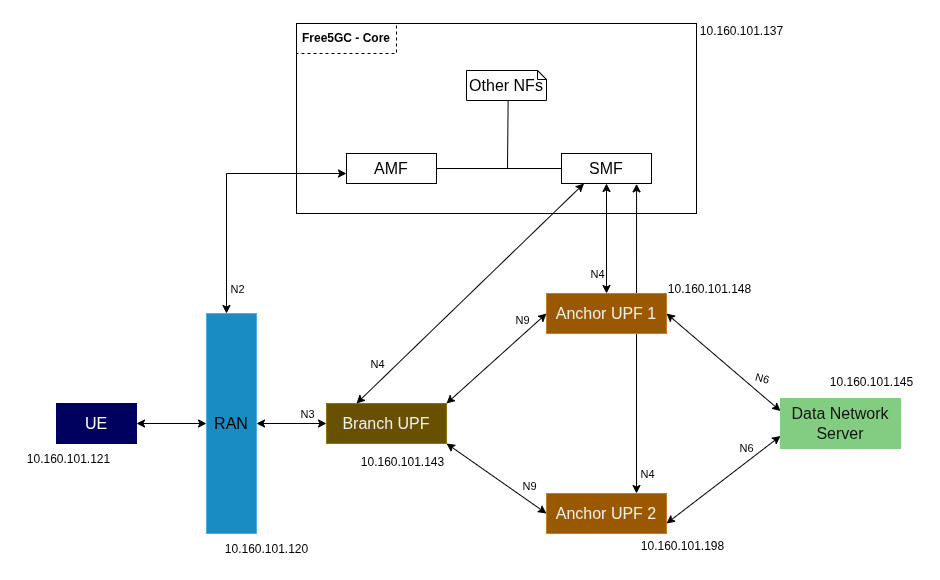
The VMs deployed in the setup are listed below:
| VM | IP Address | Role |
|---|---|---|
| free5gc-core | 10.160.101.137 | 5G Core (AMF, SMF, PCF, UDM, NRF, …) |
| ueransim-gnb | 10.160.101.120 | gNB simulator (UERANSIM) |
| ueransim-ue | 10.160.101.121 | UE simulator (UERANSIM) |
| i-upf | 10.160.101.143 | Intermediate / Branching UPF (ULCL node) |
| psa-upf | 10.160.101.148 | PSA anchor UPF 1 — default path |
| psa-upf2 | 10.160.101.198 | PSA anchor UPF 2 — steered path |
| server | 10.160.101.145 | Server / Data Network |
UE Details
| UE | IMSI | DNN | OP/OPc |
|---|---|---|---|
| UE | 208930000000001 | internet | OPc |
Traffic Paths
10.160.101.145/32 or dynamic API callPrerequisites
Required software versions for all VMs.
| Component | Version | Notes |
|---|---|---|
| free5GC | v3.3.0 | With SMF source patches (Section 6) |
| UERANSIM | latest | |
| gtp5g | v0.8.6 | With kernel patch (Section 5) — required on all UPF VMs |
| Go | 1.21+ | |
| Ubuntu | 20.04 / 22.04 | All VMs |
Build gogtp5g-tunnel
Run on I-UPF and PSA-UPF VMs only.
# Run on I-UPF and PSA-UPF VMs
git clone https://github.com/free5gc/go-gtp5gnl ~/go-gtp5gnl
cd ~/go-gtp5gnl/cmd/gogtp5g-tunnel
go build .gogtp5g-tunnel
unless actively debugging.SMF Configuration
File: /home/localadmin/free5gc/config/smfcfg.yaml — see the full document for the complete YAML.
Key points:
10.61.0.0/16), ActivateTunnelAndPDR() panics.
upfcfg.yaml. N6 is only used in smfcfg.yaml.
smfcfg.yaml
info:
  version: 1.0.7
  description: SMF initial local configuration

configuration:
  smfName: SMF # the name of this SMF

  # Service-based interface information
  sbi:
    scheme: http # the protocol for sbi (http or https)
    registerIPv4: 127.0.0.2 # IP used to register to NRF
    bindingIPv4: 127.0.0.2 # IP used to bind the service
    port: 8000 # Port used to bind the service
    tls: # the local path of TLS key
      key: cert/smf.key # SMF TLS Certificate
      pem: cert/smf.pem # SMF TLS Private key

  # the SBI services provided by this SMF, refer to TS 29.502
  serviceNameList:
    - nsmf-pdusession # Nsmf_PDUSession service
    - nsmf-event-exposure # Nsmf_EventExposure service
    - nsmf-oam # OAM service

  # the S-NSSAI list supported by this AMF
  snssaiInfos:
    - sNssai:
        sst: 1
        sd: 010203
      dnnInfos:
        - dnn: internet
          dns:
            ipv4: 8.8.8.8
            ipv6: 2001:4860:4860::8888

  # Optional: PLMN IDs configuration.
  plmnList:
    - mcc: 208 # Mobile Country Code (3 digits string, digit: 0~9)
      mnc: 93 # Mobile Network Code (2 or 3 digits string, digit: 0~9)
  locality: area1

  # PFCP configuration for N4 interface.
  pfcp:
    nodeID: 10.160.101.137 # the Node ID of this SMF
    listenAddr: 10.160.101.137 # the IP/FQDN of N4 interface on this SMF (PFCP)
    externalAddr: 10.160.101.137 # the IP/FQDN of N4 interface on this SMF (PFCP)
    assocFailAlertInterval: 10s
    assocFailRetryInterval: 30s
    heartbeatInterval: 10s

  # Userplane nodes information, specifying details for AN and UPF.
  userplaneInformation:
    upNodes:
      gNB1:
        type: AN
      I-UPF:
        type: UPF
        nodeID: 10.160.101.143
        addr: 10.160.101.143
        sNssaiUpfInfos:
          - sNssai:
              sst: 1
              sd: 010203
            dnnUpfInfoList:
              - dnn: internet
        interfaces:
          - interfaceType: N3
            endpoints:
              - 10.160.101.143
            networkInstances:
              - internet
          - interfaceType: N9
            endpoints:
              - 10.160.101.143
            networkInstances:
              - internet
      PSA-UPF:
        type: UPF
        nodeID: 10.160.101.148
        addr: 10.160.101.148
        sNssaiUpfInfos:
          - sNssai:
              sst: 1
              sd: 010203
            dnnUpfInfoList:
              - dnn: internet
                pools:
                  - cidr: 10.61.0.0/16
                staticPools:
                  - cidr: 10.60.100.0/16
        interfaces:
          - interfaceType: N9
            endpoints:
              - 10.160.101.148
            networkInstances:
              - internet
      PSA-UPF2:
        type: UPF
        nodeID: 10.160.101.198
        addr: 10.160.101.198
        sNssaiUpfInfos:
          - sNssai:
              sst: 1
              sd: 010203
            dnnUpfInfoList:
              - dnn: internet
        interfaces:
          - interfaceType: N9
            endpoints:
              - 10.160.101.198
            networkInstances:
              - internet
    links:
      - A: gNB1
        B: I-UPF
      - A: I-UPF
        B: PSA-UPF
      - A: I-UPF
        B: PSA-UPF2

  ulcl: true

  t3591:
    enable: true
    expireTime: 16s
    maxRetryTimes: 3

  t3592:
    enable: true
    expireTime: 16s
    maxRetryTimes: 3

  nrfUri: http://127.0.0.10:8000
  nrfCertPem: cert/nrf.pem
  urrPeriod: 30
  urrThreshold: 500000
  requestedUnit: 1000

logger:
  enable: true
  level: debug
reportCaller: trueUE Routing
File: /home/localadmin/free5gc/config/uerouting.yaml
ueRoutingInfo:
  UE1:
    members:
    - imsi-208930000000001
    topology:
      - A: gNB1
        B: I-UPF
      - A: I-UPF
        B: PSA-UPF
    specificPath:
      - dest: 10.160.101.145/32
        path: [I-UPF, PSA-UPF]
      - dest: 10.160.101.145/32
        path: [I-UPF, PSA-UPF2]
      - dest: 8.8.8.8/32
path: [I-UPF]FindULCL() identifies the branching point.
gtp5g Kernel Module Patch
Apply on every UPF VM: I-UPF, PSA-UPF, and PSA-UPF2.
Patch — pdr.c (~line 308)
Rebuild and Reload
cd ~/gtp5g && make clean && make
sudo cp ~/gtp5g/gtp5g.ko /lib/modules/$(uname -r)/kernel/drivers/net/gtp5g.ko
sudo rmmod gtp5g 2>/dev/null && sudo modprobe gtp5g
lsmod | grep gtp5gSMF Source Code Patches
Three Go source patches fixing bugs in free5GC v3.3.0 that prevent ULCL from working correctly.
Patch 1 — Fix PSA2 N3 Interface Check
Patch 2 — Fix FindULCL Nil Pointer
Patch 3 — Fix SDF Filter Direction
Rebuild SMF
cd ~/free5gc/NFs/smf
go build ./...
go build -o ~/free5gc/bin/smf ./cmd/Dynamic Steering API
REST endpoint on the SMF that triggers live path switching via PFCP Session Modification.
api_steering.go
package sbi

import (
    "net/http"
    "github.com/gin-gonic/gin"
)

func (s *Server) getSteeringRoutes() []Route {
    return []Route{
        { Name: "Steer Traffic", Method: http.MethodPost, Pattern: "/steer", APIFunc: s.HTTPSteerTraffic },
    }
}

func (s *Server) HTTPSteerTraffic(c *gin.Context) {
    s.Processor().HandleSteerTraffic(c)
}
steering.go
NFs/smf/internal/sbi/processor/steering.go.
Implements HandleSteerTraffic, the handler wired up by api_steering.go
above.
Contains two key bug-fixes required for multi-UE operation — see § 14 for full diffs
and root-cause analysis.
package processor

import (
    "fmt"
    "net/http"
    "github.com/free5gc/openapi/models"
    pfcpType "github.com/free5gc/pfcp/pfcpType"
    "github.com/free5gc/smf/internal/context"
    smf_context "github.com/free5gc/smf/internal/context"
    "github.com/gin-gonic/gin"
)

type SteerRequest struct {
    SUPI      string `json:"supi"`
    PDUSessID int32  `json:"pduSessId"`
    TargetUPF string `json:"targetUpf"`
}

func (p *Processor) HandleSteerTraffic(c *gin.Context) {
    var req SteerRequest
    if err := c.ShouldBindJSON(&req); err != nil {
        c.JSON(http.StatusBadRequest, gin.H{"error": err.Error()})
        return
    }
    if req.PDUSessID == 0 { req.PDUSessID = 1 }

    smContext := smf_context.GetSMContextById(req.SUPI, req.PDUSessID)
    if smContext == nil {
        c.JSON(http.StatusNotFound, gin.H{"error": "SMContext not found", "supi": req.SUPI})
        return
    }

    upi := smf_context.GetUserPlaneInformation()
    targetUPNode := upi.GetUPFNodeByIP(req.TargetUPF)
    if targetUPNode == nil {
        c.JSON(http.StatusNotFound, gin.H{"error": "Target UPF not found", "targetUpf": req.TargetUPF})
        return
    }
    targetUPF := targetUPNode.UPF
    targetUPFName := upi.GetUPFNameByIp(req.TargetUPF)

    smContext.SMLock.Lock()
    defer smContext.SMLock.Unlock()

    iface := targetUPF.GetInterface(models.UpInterfaceType_N9, smContext.Dnn)
    if iface == nil {
        c.JSON(http.StatusInternalServerError, gin.H{"error": "Target UPF has no N9 interface"})
        return
    }
    targetIP, err := iface.IP(smContext.SelectedPDUSessionType)
    if err != nil {
        c.JSON(http.StatusInternalServerError, gin.H{"error": fmt.Sprintf("Cannot get target UPF IP: %v", err)})
        return
    }

    var ulcfNodes []*context.DataPathNode
    for _, dp := range smContext.Tunnel.DataPathPool {
        if dp.IsDefaultPath { continue }
        for node := dp.FirstDPNode; node != nil; node = node.Next() {
            if node.UpLinkTunnel == nil || node.UpLinkTunnel.PDR == nil { continue }
            pdr := node.UpLinkTunnel.PDR
            if pdr.PDI.SDFFilter == nil || pdr.FAR == nil ||
               pdr.FAR.ForwardingParameters == nil ||
               pdr.FAR.ForwardingParameters.OuterHeaderCreation == nil { continue }
            ulcfNodes = append(ulcfNodes, node)
        }
    }
    if len(ulcfNodes) == 0 {
        c.JSON(http.StatusInternalServerError, gin.H{"error": "no ULCL steering FAR found pointing to old UPF"})
        return
    }

    var pdrList []*context.PDR
    var farList []*context.FAR
    debugFARs := ""
    for _, node := range ulcfNodes {
        ulFAR := node.UpLinkTunnel.PDR.FAR
        if ulFAR == nil || ulFAR.ForwardingParameters == nil { continue }
        existingTEID := uint32(0)
        if ulFAR.ForwardingParameters.OuterHeaderCreation != nil {
            existingTEID = ulFAR.ForwardingParameters.OuterHeaderCreation.Teid
        }
        ulFAR.ForwardingParameters.OuterHeaderCreation = &pfcpType.OuterHeaderCreation{
            OuterHeaderCreationDescription: pfcpType.OuterHeaderCreationGtpUUdpIpv4,
            Ipv4Address:                    targetIP,
            Teid:                           existingTEID,
        }
        ulFAR.State = smf_context.RULE_UPDATE
        pdrList = append(pdrList, node.UpLinkTunnel.PDR)
        farList = append(farList, ulFAR)
        debugFARs += fmt.Sprintf("FARID=%d,UPF=%s;",
            ulFAR.FARID, node.UPF.NodeID.ResolveNodeIdToIp().String())
    }
    if len(farList) == 0 {
        c.JSON(http.StatusInternalServerError, gin.H{"error": "no valid FARs to update"})
        return
    }
    c.Header("X-Debug-FAR", debugFARs)

    iUPFNode := ulcfNodes[0]
    resChan := make(chan SendPfcpResult, 1)
    pfcpState := &PFCPState{
        upf:     iUPFNode.UPF,
        pdrList: pdrList,
        farList: farList,
        barList: []*context.BAR{},
        qerList: nil,
        urrList: nil,
    }
    go modifyExistingPfcpSession(smContext, pfcpState, resChan, "")
    result := <-resChan
    close(resChan)

    if result.Err != nil || result.Status != smf_context.SessionUpdateSuccess {
        c.JSON(http.StatusInternalServerError, gin.H{
            "error":  fmt.Sprintf("PFCP modification failed: %v", result.Err),
            "status": result.Status,
        })
        return
    }
    smContext.SelectedUPF = targetUPNode
    c.JSON(http.StatusOK, gin.H{
        "status":    "steering applied",
        "supi":      req.SUPI,
        "targetUpf": targetUPFName,
        "targetIp":  req.TargetUPF,
    })
}Startup Order
sudo ip link delete upfgtp 2>/dev/null
cd ~/gtp5g/go-upf && sudo ./upf -c upfcfg.yaml &sudo ip link delete upfgtp 2>/dev/null
cd ~/gtp5g/go-upf && sudo ./upf -c upfcfg.yaml &sudo ip link delete upfgtp 2>/dev/null
cd ~/gtp5g/go-upf && sudo ./upf -c upfcfg.yaml &cd ~/free5gc && ./build.shcd ~/UERANSIM/build
sudo ./nr-gnb -c ../config/free5gc-gnb.yaml &cd ~/UERANSIM/build
sudo ./nr-ue -c ../config/free5gc-ue.yaml &
sleep 3 && ping -I uesimtun0 10.160.101.145 -c 3iptables / Routing Rules
PSA-UPF (10.160.101.148)
sudo iptables -t nat -A POSTROUTING -s 10.60.0.0/16 -o <N6_IFACE> -j MASQUERADE
sudo ip route add 10.160.101.145/32 dev <N6_IFACE>
PSA-UPF2 (10.160.101.198)
sudo iptables -t nat -A POSTROUTING -s 10.60.0.0/16 -o <N6_IFACE> -j MASQUERADE
sudo ip route add 10.160.101.145/32 dev <N6_IFACE>
Server VM
sudo ip route add 10.60.0.0/16 via 10.160.101.148
sudo ip route add 10.60.0.0/16 via 10.160.101.198 metric 200Using the Dynamic Steering API
127.0.0.2:8000. All
curl commands must be run on the core VM with sudo.
Use steer.sh script
./steer.sh 10.160.101.148   # steer to PSA-UPF
./steer.sh 10.160.101.198 # steer to PSA-UPF2Verification Checklist
ping -I uesimtun0 10.160.101.145
— confirm packets flow before steering.sudo tcpdump -i upfgtp -n
simultaneously on both PSA-UPF VMs.sudo dmesg | tail -10 —
should NOT contain No PDR match this skb.Troubleshooting
sudo ip link delete upfgtpSelf-Healing Agent
The use case that ties the whole testbed together: an autonomous agent running on
free5gc-core that detects a GTP-U flood from live traffic and heals the network on its own,
with no human in the loop. Its "brain" is an LSTM classifier; its hands are the Dynamic Steering API from
§ 07. When it confirms an attack it steers only the malicious UEs onto the backup
anchor, leaving the legitimate UEs on their original path completely untouched.
Closed loop at a glance
Every two seconds the agent runs two probes concurrently, feeds the result to the LSTM, and — once an attack persists past a short confirmation window — issues per-UE steering calls:
/nsmf-steering/v1/steerRoles & addresses
| Constant | Value | Role |
|---|---|---|
| I_UPF_IP | 10.160.101.143 | Flood probe + ping source (SSH target, ens18) |
| FREE5GC_IP | 10.160.101.137 | Core — runs the steering curl calls |
| MONITOR_IP | 10.160.101.148 | PSA-UPF (active) — normal UEs stay here |
| FAILOVER_IP | 10.160.101.198 | PSA-UPF2 (backup) — malicious UEs steered here |
UE assignment
| Class | SUPIs | On healing |
|---|---|---|
| Normal (6) | imsi-…008, …001, …003, …006, …002, …004 | Kept on PSA-UPF (10.160.101.148) |
| Malicious (2) | imsi-…007 (uesimtun0), imsi-…005 (uesimtun1) | Steered to PSA-UPF2 (10.160.101.198) |
Detection — LSTM only
There is no hand-tuned threshold in the decision path. Each poll's 11 features are scaled and passed through the classifier, which emits a class label. The label alone drives the response:
| Class | Label | Response |
|---|---|---|
| 0 | NORMAL | No action; detection state reset |
| 4 | GTP_FLOOD | Steer the 2 malicious UEs only |
| other ≠ 0 | GRAY_FAILURE | Steer ALL 8 UEs to the backup anchor |
CONFIRM_SECS = 4 before healing fires. A single noisy poll will not trigger steering; if the
signal clears first, the timer resets.Feature vector (11 inputs)
Collected per poll from I-UPF's ens18 via
tcpdump -tt -nn 'udp port 2152' -c 1000 (2 s window):
packet_count, byte_count, avg_packet_size,
min_packet_size, max_packet_size, packet_size_variance,
inter_arrival_time_mean, inter_arrival_time_variance,
packet_rate_pps, ul_bitrate, dl_bitrate.
Healing action
On a confirmed GTP_FLOOD, steer_list() SSHes into the core and POSTs one steering
request per malicious SUPI to http://127.0.0.2:8000/nsmf-steering/v1/steer. It parses the
X-Debug-FAR response header for each call, records the updated FARIDs, and treats
the heal as successful only if every targeted UE returns a FARID. The agent then prints its convergence
metrics (attack type, pps at detection, time-to-heal, total convergence, and the normal/malicious split) and
exits.
Running it
free5gc-core and i-upf; passwordless sudo tcpdump on i-upf; and the
three model assets present under model/
(lstm_attack_classifier.pth, scaler.pkl, label_encoder.pkl).cd ~/agent
python3 agent_main.pyAt startup the agent logs its configuration banner (monitored anchors, normal vs. malicious SUPIs, confirmation delay) and then one line per poll showing N9 loss and the observed GTP-U pps, so you can watch the flood build and the heal fire in real time.
agent_main.py
#!/usr/bin/env python3
import subprocess, time, re, logging, threading
import joblib
import torch
import torch.nn as nn
import numpy as np

# ─────────────────────────────────────────────
# CONFIG
# ─────────────────────────────────────────────
I_UPF_IP       = "10.160.101.143"
I_UPF_USER     = "localadmin"
FREE5GC_IP     = "10.160.101.137"
FREE5GC_USER   = "localadmin"
MONITOR_IP     = "10.160.101.148"        # psa-upf  (active)
FAILOVER_IP    = "10.160.101.198"        # psa-upf2 (backup)

SUPI_NORMAL = [
    "imsi-208930000000008",  # uesimtun2 → 10.61.0.3
    "imsi-208930000000001",  # uesimtun3 → 10.61.0.4
    "imsi-208930000000003",  # uesimtun4 → 10.61.0.5
    "imsi-208930000000006",  # uesimtun5 → 10.61.0.6
    "imsi-208930000000002",  # uesimtun6 → 10.61.0.7
    "imsi-208930000000004",  # uesimtun7 → 10.61.0.8
]

# Malicious UEs → steered to PSA-UPF2 on GTP_FLOOD
SUPI_MALICIOUS = [
    "imsi-208930000000007",  # uesimtun0 → 10.61.0.1
    "imsi-208930000000005",  # uesimtun1 → 10.61.0.2
]

STEER_URL      = "http://127.0.0.2:8000/nsmf-steering/v1/steer"
CONFIRM_SECS   = 4

# LSTM classifier assets
CLASSIFIER_MODEL  = "model/lstm_attack_classifier.pth"
CLASSIFIER_SCALER = "model/scaler.pkl"
CLASSIFIER_LE     = "model/label_encoder.pkl"

CLASS_NORMAL    = 0
CLASS_GTP_FLOOD = 4  # confirmed from your LSTM output

logging.basicConfig(level=logging.INFO, format='%(asctime)s %(message)s')
log = logging.getLogger()


# ─────────────────────────────────────────────
# 1. LSTM MODEL DEFINITION
# ─────────────────────────────────────────────
class LSTMAttackClassifier(nn.Module):
    def __init__(self, input_size, hidden_size=64, num_layers=2, num_classes=5):
        super().__init__()
        self.lstm    = nn.LSTM(input_size, hidden_size, num_layers,
                               batch_first=True, dropout=0.2)
        self.fc      = nn.Linear(hidden_size, num_classes)
        self.dropout = nn.Dropout(0.2)

    def forward(self, x):
        _, (hn, _) = self.lstm(x)
        out = self.dropout(hn[-1])
        return self.fc(out)


# ─────────────────────────────────────────────
# 2. LOAD CLASSIFIER ASSETS
# ─────────────────────────────────────────────
def load_classifier():
    try:
        import warnings
        warnings.filterwarnings("ignore")

        scaler = joblib.load(CLASSIFIER_SCALER)
        le     = joblib.load(CLASSIFIER_LE)

        input_size  = scaler.n_features_in_
        num_classes = len(le.classes_)

        model = LSTMAttackClassifier(input_size=input_size, num_classes=num_classes)
        model.load_state_dict(torch.load(CLASSIFIER_MODEL, map_location='cpu'))
        model.eval()

        log.info(f"[CLASSIFIER] Loaded — input_size={input_size}, classes={le.classes_}")
        return model, scaler, le

    except Exception as e:
        log.error(f"[CLASSIFIER] Failed to load: {e}")
        log.error("LSTM model is required. Cannot run without classifier.")
        raise SystemExit(1)


# ─────────────────────────────────────────────
# 3. FEATURE COLLECTION
# ─────────────────────────────────────────────
FEATURE_COLS = [
    "packet_count", "byte_count", "avg_packet_size",
    "min_packet_size", "max_packet_size", "packet_size_variance",
    "inter_arrival_time_mean", "inter_arrival_time_variance",
    "packet_rate_pps", "ul_bitrate", "dl_bitrate"
]

def collect_flood_features():
    empty_features = {col: 0.0 for col in FEATURE_COLS}

    try:
        start = time.time()
        cmd   = "sudo tcpdump -i ens18 -tt -nn 'udp port 2152' -c 1000"

        r = subprocess.run(
            ["ssh", f"{I_UPF_USER}@{I_UPF_IP}", cmd],
            capture_output=True, text=True, timeout=2
        )

        elapsed   = time.time() - start
        lines     = [l for l in r.stdout.splitlines() if "UDP" in l and "length" in l]
        pkt_count = len(lines)

        if pkt_count == 0:
            return empty_features, 0

        timestamps = []
        sizes      = []

        for line in lines:
            ts_match = re.match(r'^(\d+\.\d+)', line)
            if ts_match:
                timestamps.append(float(ts_match.group(1)))

            sz_match = re.search(r'length\s+(\d+)', line, re.IGNORECASE)
            if sz_match:
                sizes.append(int(sz_match.group(1)))

        if not sizes:
            return empty_features, 0

        sizes_arr  = np.array(sizes, dtype=np.float64)
        byte_count = float(sizes_arr.sum())
        pkt_rate   = pkt_count / elapsed if elapsed > 0 else 0
        ul_bitrate = (byte_count * 8) / elapsed if elapsed > 0 else 0

        if len(timestamps) >= 2:
            iats     = np.diff(sorted(timestamps))
            iat_mean = float(iats.mean())
            iat_var  = float(iats.var())
        else:
            iat_mean = 0.0
            iat_var  = 0.0

        features = {
            "packet_count"               : float(pkt_count),
            "byte_count"                 : byte_count,
            "avg_packet_size"            : float(sizes_arr.mean()),
            "min_packet_size"            : float(sizes_arr.min()),
            "max_packet_size"            : float(sizes_arr.max()),
            "packet_size_variance"       : float(sizes_arr.var()),
            "inter_arrival_time_mean"    : iat_mean,
            "inter_arrival_time_variance": iat_var,
            "packet_rate_pps"            : pkt_rate,
            "ul_bitrate"                 : ul_bitrate,
            "dl_bitrate"                 : 0.0,
        }

        return features, int(pkt_rate)

    except subprocess.TimeoutExpired:
        return empty_features, 0
    except Exception as e:
        log.warning(f"[COLLECTOR] Failed: {e}")
        return empty_features, 0


# ─────────────────────────────────────────────
# 4. INFERENCE HELPER
# ─────────────────────────────────────────────
def classify_metrics(model, scaler, le, metrics: dict) -> int:
    try:
        row        = np.array([[metrics.get(col, 0.0) for col in FEATURE_COLS]], dtype=np.float32)
        row_scaled = scaler.transform(row)
        tensor     = torch.FloatTensor(row_scaled).unsqueeze(1)

        with torch.no_grad():
            outputs = model(tensor)
            _, pred = torch.max(outputs, 1)

        return int(le.inverse_transform(pred.numpy())[0])

    except Exception as e:
        log.warning(f"[CLASSIFIER] Inference error: {e}")
        return CLASS_NORMAL


# ─────────────────────────────────────────────
# 5. AGENT HELPERS
# ─────────────────────────────────────────────
def ping_loss_detail(ip):
    r = subprocess.run(
        ["ssh", f"{I_UPF_USER}@{I_UPF_IP}",
         f"ping -c 10 -i 0.2 -W 1 {ip}"],
        capture_output=True, text=True)

    loss = 100.0
    sent = received = lost = 0
    seqs = []

    for line in r.stdout.splitlines():
        seq_match = re.search(r'icmp_seq=(\d+)', line)
        if seq_match:
            seqs.append(int(seq_match.group(1)))

        if "packet loss" in line:
            parts = line.split(",")
            try:
                sent     = int(parts[0].strip().split()[0])
                received = int(parts[1].strip().split()[0])
                lost     = sent - received
                loss     = float(parts[2].strip().split("%")[0])
            except Exception:
                pass

    return loss, sent, received, lost, seqs[0] if seqs else None, seqs[-1] if seqs else None


def steer_list(supi_list, target_ip):
    """
    SSH into free5gc-core and run steering logic for the given SUPI list.
    Mirrors steering.sh logic exactly.
    Returns True if ALL UEs steered successfully.
    """
    supi_array = " ".join(f'"{s}"' for s in supi_list)

    bash_cmd = f"""
SUPI_LIST=({supi_array})
TARGET="{target_ip}"
SUCCESS=0
FAIL=0
printf "%-28s | %-10s | %-20s\\n" "SUPI" "STATUS" "FARIDs"
echo "------------------------------------------------------------"
for SUPI in "${{SUPI_LIST[@]}}"; do
    RESULT=$(curl -s -v -X POST http://127.0.0.2:8000/nsmf-steering/v1/steer \\
        -H 'Content-Type: application/json' \\
        -d "{{\\\"supi\\\":\\\"$SUPI\\\",\\\"targetUpf\\\":\\\"$TARGET\\\"}}" 2>&1)
    FARIDS=$(echo "$RESULT" | grep -i "x-debug-far" | grep -oP 'FARID=\\K\\d+' | paste -sd "," -)
    if [ -z "$FARIDS" ]; then
        printf "%-28s | %-10s | %-20s\\n" "$SUPI" "FAILED" "N/A"
        FAIL=$((FAIL+1))
    else
        printf "%-28s | %-10s | %-20s\\n" "$SUPI" "SUCCESS" "$FARIDS"
        SUCCESS=$((SUCCESS+1))
    fi
    sleep 0.5
done
echo "------------------------------------------------------------"
echo "Steered $SUCCESS/${{#SUPI_LIST[@]}} UEs to $TARGET"
[ $FAIL -eq 0 ] && exit 0 || exit 1
"""

    r = subprocess.run(
        ["ssh", f"{FREE5GC_USER}@{FREE5GC_IP}", "bash", "-s"],
        input=bash_cmd,
        capture_output=True, text=True,
        timeout=60
    )

    for line in r.stdout.splitlines():
        log.info(f"  {line}")
    if r.returncode != 0 and r.stderr:
        log.error(f"  [stderr] {r.stderr[:200]}")

    return r.returncode == 0

def log_convergence(attack_label, time_to_heal, total_converge,
                    first_detection, last_detection,
                    polls_to_detection, pps_at_detection,
                    normal_ue_count, malicious_ue_count):
    log.info("=" * 60)
    log.info("CONVERGENCE METRICS")
    log.info(f"  Attack type          : {attack_label}")
    log.info(f"  PPS at detection     : {pps_at_detection}")
#    log.info(f"  Polls to detection   : {polls_to_detection}")
    log.info(f"  Time to heal         : {time_to_heal:.2f}s")
    log.info(f"  Total convergence    : {total_converge:.2f}s")
#    log.info(f"  Confirmation window  : {CONFIRM_SECS}s")
    log.info("=" * 60)
    log.info("STEERING SUMMARY")
    log.info(f"  Normal UEs kept      : {normal_ue_count} → {MONITOR_IP}")
    log.info(f"  Malicious UEs steered: {malicious_ue_count} → {FAILOVER_IP}")
    log.info("=" * 60)
    log.info("DETECTION TIMELINE")
    log.info(f"  First detection      : {time.strftime('%H:%M:%S', time.localtime(first_detection))}")
    log.info(f"  Healing complete     : {time.strftime('%H:%M:%S', time.localtime(last_detection))}")
    log.info(f"  Duration             : {last_detection - first_detection:.2f}s")
    log.info("=" * 60)

# ─────────────────────────────────────────────
# 6. MAIN AGENT LOOP (LSTM-ONLY DETECTION)
# ─────────────────────────────────────────────
def main():
    clf_model, clf_scaler, clf_le = load_classifier()

    log.info("=" * 60)
    log.info("AGENT STARTED — LSTM-ONLY DETECTION MODE")
    log.info("=" * 60)
    log.info(f"  Monitoring N9       : {I_UPF_IP} → {MONITOR_IP}")
    log.info(f"  Flood probe         : {I_UPF_IP}:ens18 (UDP port 2152)")
    log.info(f"  Steer API           : {FREE5GC_IP} → {STEER_URL}")
    log.info(f"  Normal UEs          : {[s[-4:] for s in SUPI_NORMAL]} → stay on {MONITOR_IP}")
    log.info(f"  Malicious UEs       : {[s[-4:] for s in SUPI_MALICIOUS]} → steer to {FAILOVER_IP}")
    log.info(f"  Confirmation delay  : {CONFIRM_SECS}s")
    log.info(f"  Detection mode      : PURE LSTM (ML-based)")
    log.info("=" * 60)

    t_detected         = None
    first_detection    = None
    attack_label       = "UNKNOWN"
    poll_count         = 0       # ← NEW
    polls_to_detection = 0       # ← NEW
    pps_at_detection   = 0       # ← NEW

    while True:
        ping_result  = {}
        flood_result = {}

        def run_ping():
            loss, sent, received, lost, fs, ls = ping_loss_detail(MONITOR_IP)
            ping_result.update({
                "loss": loss, "sent": sent, "received": received,
                "lost": lost, "first_seq": fs, "last_seq": ls
            })

        def run_flood_probe():
            features, pps = collect_flood_features()
            flood_result.update({"features": features, "pps": pps})

        t1 = threading.Thread(target=run_ping,        daemon=True)
        t2 = threading.Thread(target=run_flood_probe, daemon=True)
        t1.start(); t2.start()
        t1.join();  t2.join()

        loss      = ping_result.get("loss", 0.0)
        sent      = ping_result.get("sent", 0)
        lost      = ping_result.get("lost", 0)
        first_seq = ping_result.get("first_seq")
        last_seq  = ping_result.get("last_seq")
        features  = flood_result.get("features", {})
        pps       = flood_result.get("pps", 0)

        poll_count += 1  # ← NEW

        log.info(
            f"[Poll #{poll_count}] N9 loss={loss:.1f}%  sent={sent}  lost={lost}  "
            f"seqs={first_seq}-{last_seq}  |  ens18 GTP-U pps={pps}"
        )

        # ── LSTM-ONLY DETECTION ───────────────────────────────────────────
        attack_detected = False
        detected_class  = classify_metrics(clf_model, clf_scaler, clf_le, features)

        if detected_class == CLASS_GTP_FLOOD:
            attack_detected = True
            attack_label    = "GTP_FLOOD"
            log.warning(
                f"[LSTM] GTP_FLOOD detected "
                f"(class={detected_class}, pps={pps}, loss={loss:.1f}%)"
            )
        elif detected_class != CLASS_NORMAL:
            attack_detected = True
            attack_label    = "GRAY_FAILURE"
            log.warning(
                f"[LSTM] GRAY_FAILURE detected "
                f"(class={detected_class}, pps={pps}, loss={loss:.1f}%)"
            )

        # ── HEALING LOGIC ─────────────────────────────────────────────────
        if attack_detected:
            if t_detected is None:
                t_detected         = time.time()
                first_detection    = t_detected
                polls_to_detection = poll_count   # ← NEW
                pps_at_detection   = pps          # ← NEW
                log.info(
                    f"⚠ Attack detected at poll #{polls_to_detection} "
                    f"(pps={pps_at_detection}) — confirming for {CONFIRM_SECS}s..."
                )

            elif time.time() - t_detected > CONFIRM_SECS:
                log.warning(f"✓ Attack CONFIRMED ({attack_label}) — initiating healing...")
                t_heal = time.time()

                if attack_label == "GTP_FLOOD":
                    log.info(f"  → Keeping  {len(SUPI_NORMAL)} normal UEs on {MONITOR_IP}")
                    log.info(f"  → Steering {len(SUPI_MALICIOUS)} malicious UEs to {FAILOVER_IP}")

                    if steer_list(SUPI_MALICIOUS, FAILOVER_IP):
                        time_to_heal   = time.time() - t_heal
                        total_converge = time.time() - t_detected

                        log_convergence(
                            attack_label, time_to_heal, total_converge,
                            first_detection, time.time(),
                            polls_to_detection, pps_at_detection,  # ← NEW
                            len(SUPI_NORMAL), len(SUPI_MALICIOUS)  # ← NEW
                        )
                        log.info("Agent terminating after successful healing.")
                        break
                    else:
                        log.error("Steering failed — retrying...")
                        t_detected = None

                else:
                    log.info(f"  → Steering ALL {len(SUPI_NORMAL + SUPI_MALICIOUS)} UEs to {FAILOVER_IP}")

                    if steer_list(SUPI_NORMAL + SUPI_MALICIOUS, FAILOVER_IP):
                        time_to_heal   = time.time() - t_heal
                        total_converge = time.time() - t_detected

                        log_convergence(
                            attack_label, time_to_heal, total_converge,
                            first_detection, time.time(),
                            polls_to_detection, pps_at_detection,
                            len(SUPI_NORMAL), len(SUPI_MALICIOUS)
                        )
                        log.info("Agent terminating after successful healing.")
                        break
                    else:
                        log.error("Steering failed — retrying...")
                        t_detected = None

        else:
            if t_detected is not None:
                log.info("✓ Attack cleared — resetting detection state")
            t_detected = None

        time.sleep(2)

if __name__ == "__main__":
    try:
        main()
    except KeyboardInterrupt:
        log.info("\nAgent stopped by user")
    except Exception as e:
        log.error(f"Agent crashed: {e}", exc_info=True)
Multi-UE Steering
The original single-UE steering.go handler worked for one session but silently failed with
multiple UEs. Two root-cause bugs were fixed; the corrected handler is the one shown in full in § 07.
Bug A — stale-IP guard broke idempotency
The original FAR-collection loop guarded on the FAR's current OuterHeaderCreation IP, treating a
FAR that didn't match the "old" UPF as already handled and skipping it. The fix removes that guard and instead
collects every non-default data-path node whose uplink PDR has an SDF filter, a FAR, and an
OuterHeaderCreation — regardless of where it currently points.
Bug B — only the first FAR was updated
ulcfNodes[0].The fix loops over all collected nodes, rewrites each FAR's OuterHeaderCreation to the target
UPF (preserving each existing TEID), appends each to farList/pdrList, and sends them
all in a single PFCP Session Modification to the I-UPF.
X-Debug-FAR response header
lists every FARID that was updated and the UPF each now points to — so you can confirm at
a glance that all targeted UEs (and only those) were steered.Helpful Links
Upstream projects and references used across this implementation.
| Resource | Link |
|---|---|
| ULCL 2-anchor sample config (s5uishida) | github.com/s5uishida/free5gc_ueransim_ulcl_2_sample_config |
| go-upf (UPF implementation) | github.com/free5gc/go-upf |
| free5GC core | github.com/free5gc/free5gc |
| gtp5g kernel module | github.com/free5gc/gtp5g |
| go-gtp5gnl (gogtp5g-tunnel) | github.com/free5gc/go-gtp5gnl |
| UERANSIM (gNB / UE simulator) | github.com/aligungr/UERANSIM |